As businesses pursue digital transformation, automation has become both an opportunity and a challenge. Two of the most discussed technologies—Robotic Process Automation (RPA) and Artificial Intelligence (AI)—promise dramatic efficiency gains, but they address very different problems. Choosing the right tool can be the difference between quick wins and expensive detours. This article compares RPA and AI, explains when each technology shines, and shows how combining them can unlock the next level of intelligent automation.

Ready to implement AI?
Get a free audit to discover automation opportunities for your business.
Why automation matters
The push toward automation is no longer optional. A Deloitte survey found that 53 % of businesses have implemented RPA and that 78 % of organizations either have RPA in place or are planning to implement it. Analysts estimate that around 45 % of business tasks are candidates for automation, and the global RPA market was valued at US$22.79 billion in 2024 with a projected compound annual growth rate (CAGR) of 43.9 %. On the AI side, adoption has accelerated as well; surveys show that 72 % of companies were using some form of AI by 2024, and 92 % plan to invest in generative AI in the next few years. These numbers reflect a simple reality: automation technologies are now mainstream, and business leaders need to understand their strengths and limits.
What is RPA?
Want results like this for your business?
Our AI audit identifies $50K-500K+ in annual savings and revenue opportunities.
Get Free AI AuditThe push toward automation is no longer optional. A Deloitte survey found that 53 % of businesses have implemented RPA and that 78 % of organizations either have RPA in place or are planning to implement it. Analysts estimate that around 45 % of business tasks are candidates for automation, and the global RPA market was valued at US$22.79 billion in 2024 with a projected compound annual growth rate (CAGR) of 43.9 %. On the AI side, adoption has accelerated as well; surveys show that 72 % of companies were using some form of AI by 2024, and 92 % plan to invest in generative AI in the next few years. These numbers reflect a simple reality: automation technologies are now mainstream, and business leaders need to understand their strengths and limits.
What is RPA?
RPA is software that uses bots to emulate human actions on computer interfaces. RPA bots can open emails, move data between applications, fill out forms and perform other rule‑based, repetitive tasks. Because the bots follow explicit instructions and interact with applications like a person would, they can be deployed quickly without changing underlying systems. Key characteristics of RPA include:
Strictly rule‑based: bots follow only the directions programmed into them; there is no built‑in learning ability. This makes RPA reliable for tasks with clear steps but unsuitable for situations that require judgment.
Ideal for structured data: bots work best with structured or semi‑structured data and predefined workflows. They excel at downloading files, entering data into ERP systems or generating routine reports.
Non‑invasive deployment: RPA sits on top of existing applications; it doesn't require altering core systems. Bots scale up or down quickly and operate around the clock, boosting accuracy and compliance.
Rapid ROI: because RPA automates high‑volume manual work, it delivers fast returns—Deloitte estimates first‑year ROI between 30 % and 200 %. Reported benefits include improved compliance (92 %), productivity (86 %), cost reduction (59 %) and higher job satisfaction (89 %).
Despite these advantages, RPA is limited by its dependence on rules and structured data. It cannot learn or adapt on its own, so any change in the process requires reprogramming.
What is AI?
AI is a broad field covering technologies that mimic cognitive functions such as learning, reasoning and perception. In the context of business automation, AI encompasses machine learning (ML), natural language processing (NLP) and computer vision. These technologies enable machines to analyze large datasets, recognize patterns, extract information from text or images and make decisions. AI's key attributes include:
Ability to handle unstructured data: unlike RPA, AI can process text, images, audio and other unstructured inputs. For example, AI models can extract information from handwritten invoices or classify sentiment in customer emails.
Learning and adaptability: AI systems improve over time by learning from data and feedback. They can adapt to new scenarios without explicit reprogramming. This makes AI suitable for tasks such as predictive analytics, risk assessment and natural language understanding.
Advanced decision‑making: AI's predictive models help businesses uncover trends and opportunities that human analysts might miss. AI can automate complex cognitive tasks that traditionally required expert judgment, such as detecting fraud or recommending personalized product bundles.
However, AI implementations typically require more data, specialized expertise and longer lead times than RPA. Success depends on high‑quality data and skilled data‑science teams.
RPA vs. AI: Key differences
While both technologies automate work, they differ fundamentally:
| Aspect | RPA | AI |
|---|---|---|
| Nature of automation | Executes tasks via user interfaces following explicit rules and predefined workflows | Performs decision‑making and learning‑type tasks using algorithms that can recognize patterns and adapt |
| Learning ability | Does not learn from experience; any change requires reprogramming | Learns from data, improving performance and adapting to new inputs over time |
| Task complexity | Suitable for simple, repetitive and highly predictable processes | Handles complex, dynamic tasks involving interpretation, prediction or judgment |
| Data handling | Works best with structured data (tables, forms) | Can process both structured and unstructured data such as text, images and audio |
| Adaptability | Requires human intervention to adjust when workflows change | Adapts autonomously by learning from new data and feedback |
| Expertise required | Implementation can often be handled by business analysts and process specialists | Requires data scientists and AI engineers to build and maintain models and ensure ethical, explainable outcomes |
When should you deploy RPA, and when should you bring in AI?
Start with RPA for quick wins. RPA is best suited for processes that are repetitive and time‑intensive, involve high volumes of structured data, follow set rules and require minimal human judgment. Example workflows include data entry, order processing, report generation and data migration. RPA lays the foundation for automation by orchestrating tasks across systems and reducing human workload.
Add AI for complexity and unstructured data. Once RPA has streamlined the basics, AI can take automation to the next level. Processes that require predictive analytics, handle unstructured or semi‑structured data, or rely on natural language understanding are ideal candidates for AI. AI augments decision‑making by analyzing patterns in data, forecasting outcomes and personalizing interactions. For example, machine‑learning models can classify invoices of different formats and extract data, while NLP algorithms interpret customer messages and guide bots accordingly.
Assess flexibility and ROI. RPA offers rapid deployment and predictable ROI for well‑defined processes, while AI requires more investment but delivers deeper insights and adaptability. Businesses often start with RPA to capture immediate benefits and then integrate AI to handle exceptions and continually optimize processes.
Working together: Intelligent automation
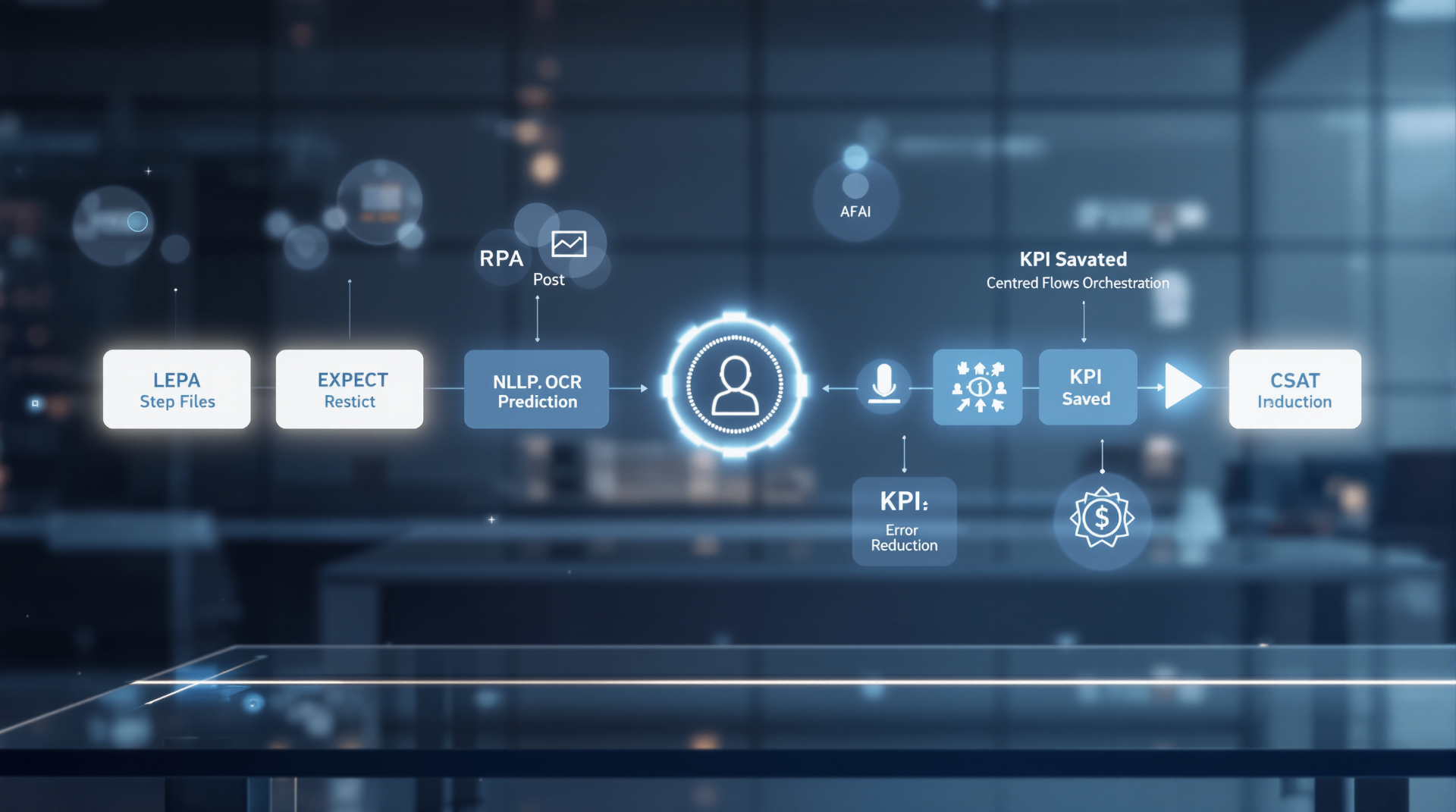
Rather than viewing RPA and AI as competing technologies, leading organizations treat them as complementary components of intelligent automation. This integration—sometimes called hyperautomation—combines RPA's speed and reliability with AI's cognitive abilities:
Augmented decision‑making: AI's cognitive power enhances RPA workflows by enabling bots to handle exceptions and make data‑driven decisions.
Continuous learning and optimization: AI can analyze logs from RPA processes, identify inefficiencies and recommend improvements. Over time, this creates a feedback loop where automation gets smarter and more efficient.
Enhanced customer experience: AI's natural language and sentiment analysis personalize customer interactions, while RPA ensures quick, error‑free execution of back‑office tasks. This combination can tailor responses based on customer preferences and deliver faster resolutions.
Adaptive compliance and risk management: AI monitors transactions and detects anomalies in real time, adding a layer of adaptive compliance to RPA‑driven processes. This reduces the risk of regulatory breaches and fraud.
Integration of AI and RPA leads to full process automation, cost efficiency, superior customer experience and scalability. By combining the technologies, companies can automate both routine and complex tasks, reduce human error, and scale automation to new functions.
Deciding what's right for your business
Map your processes. Identify high‑volume, rule‑based tasks where RPA can deliver immediate savings. Use process discovery to uncover automation opportunities.
Evaluate data and complexity. For processes involving unstructured data, variable formats or predictive analytics, AI may be necessary. Consider whether the process requires cognitive judgment or is purely mechanical.
Plan for growth. Start with RPA for quick wins and gradually integrate AI to handle complexity and continuous improvement. Work with cross‑functional teams to ensure data quality and governance.
Measure ROI. Track metrics such as time saved, error reduction and customer satisfaction. Remember that RPA typically yields ROI of 30–200 % in the first year, while AI projects may require longer horizons but deliver transformative insights and scalability.
Conclusion
RPA and AI are both powerful automation tools—but they serve different purposes. RPA excels at automating high‑volume, rules‑driven tasks quickly and reliably. AI brings cognitive capabilities, enabling machines to interpret unstructured data, learn from experience and make decisions. Intelligent automation combines the strengths of both technologies: RPA provides the execution layer, while AI adds intelligence and adaptability. For most businesses, the smartest strategy is to start with RPA to achieve immediate efficiencies and then expand into AI‑driven automation as data maturity and complexity increase. The future belongs to organizations that leverage both, orchestrating human and machine workflows to drive productivity, cost savings and innovation.