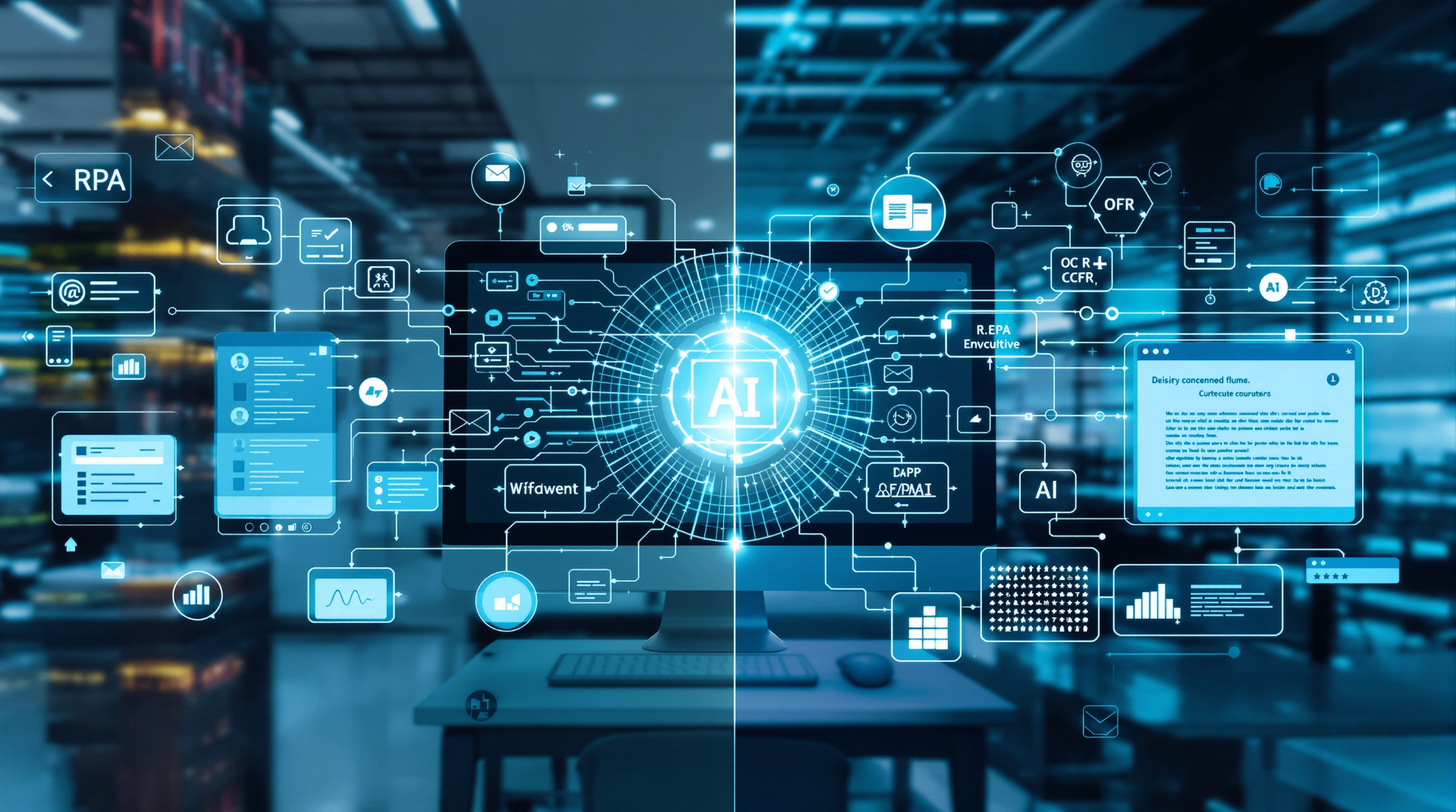
Automation technologies are evolving from simple task‑oriented scripts into complex ecosystems that weave together artificial intelligence (AI), machine learning (ML), robotics and networked devices. Forward‑looking companies are investing in these tools not just to cut costs, but to become more resilient and innovative. Below are seven trends that will shape how businesses automate over the next few years, along with the opportunities and challenges they present.

Ready to implement AI?
Get a free audit to discover automation opportunities for your business.
1. Integration of AI and Machine Learning
The marriage of AI and automation allows systems to make smarter decisions and continuously improve. Machine‑learning models can analyse historical data, learn patterns and adapt process logic on the fly. In practice, this means automated workflows become predictive rather than reactive: service desks can anticipate customer requests, supply chains can re‑order parts before stockouts occur, and financial processes can flag anomalies before they become costly errors.
What it means for business: Smarter automation reduces manual oversight and improves the accuracy of decisions. Teams gain deeper insights into process performance, enabling them to fine‑tune operations and respond quickly to changing conditions.
2. Expansion of Robotic Process Automation (RPA)

RPA bots handle repetitive tasks such as data entry, invoice processing and system integrations. Early deployments focused on isolated back‑office tasks, but now organisations are scaling RPA across departments and integrating bots with AI models and business applications. Modern RPA tools offer low‑code interfaces, making it easier for non‑technical staff to build and manage their own bots.
What it means for business: RPA frees employees from mundane work so they can focus on creative, high‑value activities. Scaled across the enterprise, it can significantly reduce turnaround times and increase throughput without increasing headcount.
3. Hyperautomation

Hyperautomation refers to orchestrating multiple automation technologies—RPA, AI/ML, business process management and low‑code platforms—to automate end‑to‑end processes. It recognises that no single tool can handle every scenario; instead, it combines strengths to automate complex workflows, manage exceptions and enable seamless handoffs between digital workers and humans.
What it means for business: Hyperautomation creates a flexible "digital worker" layer that augments human teams. By automating entire value chains, organisations can improve consistency, reduce errors and rapidly scale operations to meet demand.
4. Growth of Industrial Internet of Things (IIoT)
In manufacturing and asset‑intensive industries, the Industrial Internet of Things (IIoT) connects machinery, sensors and equipment to central analytics platforms. Sensor data about temperature, vibration, pressure and other parameters feeds predictive‑maintenance algorithms that identify potential failures before they happen. IIoT also enables real‑time production optimisation, remote monitoring and energy management.
What it means for business: Connecting devices and leveraging analytics can cut unplanned downtime, extend equipment life and increase overall equipment effectiveness. Operations teams gain visibility into performance and can make better maintenance and production decisions.
5. 5G and Edge Computing for Real‑Time Processing
Low‑latency 5G networks and edge‑computing architectures enable data to be processed closer to where it is generated. In logistics, transportation and smart‑city initiatives, real‑time processing supports dynamic routing, autonomous vehicles and adaptive traffic management. In manufacturing, edge‑enabled automation allows robots and machines to respond instantly to sensor data without relying on distant cloud servers.
What it means for business: Real‑time decision‑making unlocks new use cases and improves the performance of existing ones. Companies can respond to events as they happen, improving safety, efficiency and customer satisfaction while lowering networking and cloud costs.
6. Collaborative Robots (Cobots)
Unlike traditional industrial robots that work behind safety cages, collaborative robots are designed to work safely alongside humans. Cobots can be programmed quickly, require smaller footprints and can switch between tasks throughout the day. They are being deployed in assembly lines, warehouses, laboratories and even small shops to assist with heavy lifting, precision tasks and repetitive movements.
What it means for business: Cobots amplify human labour rather than replacing it. They improve workplace ergonomics, increase output and make automation accessible to smaller companies that previously couldn't justify investing in traditional robotics.
7. Enhanced Cybersecurity for Automated Systems

As automation platforms, connected devices and AI agents proliferate, the attack surface for cyber‑criminals grows. Enterprises are therefore investing in integrated security frameworks, including zero‑trust architectures, continuous monitoring and AI‑driven threat detection. Governance and compliance processes are being built into automation pipelines to ensure data privacy, model transparency and responsible AI usage.
What it means for business: Secure automation protects intellectual property and sensitive information while ensuring compliance with evolving regulations. By embedding security and governance into automated workflows, companies can confidently scale their digital operations.
Conclusion
The automation landscape is evolving rapidly. Integration of AI and machine learning is making processes smarter and more autonomous, while technologies like RPA, IIoT, edge computing and cobots expand the scope of what can be automated. To realise the full benefits, organisations must think holistically: build a technology stack that blends these tools, invest in cybersecurity and governance, and focus on how automation augments rather than replaces human talent. With a clear strategy, businesses can harness these trends to become more efficient, resilient and innovative.